

Your lawmakers need to hear from you.
Right to Repair is won state by state, in state capitols, by constituents. It takes about 90 seconds to tell your legislators you want the right to fix what you own — and we've already written the letter.
Step 1: Email Your State Lawmakers
Right to Repair is decided in state legislatures — 50 separate fights, each one winnable. Your legislators track constituent mail closely, and repair bills usually pass or die by a handful of votes.
Pick your state. We'll find your legislators from your address and give you a letter you can send as-is or rewrite in your own words.
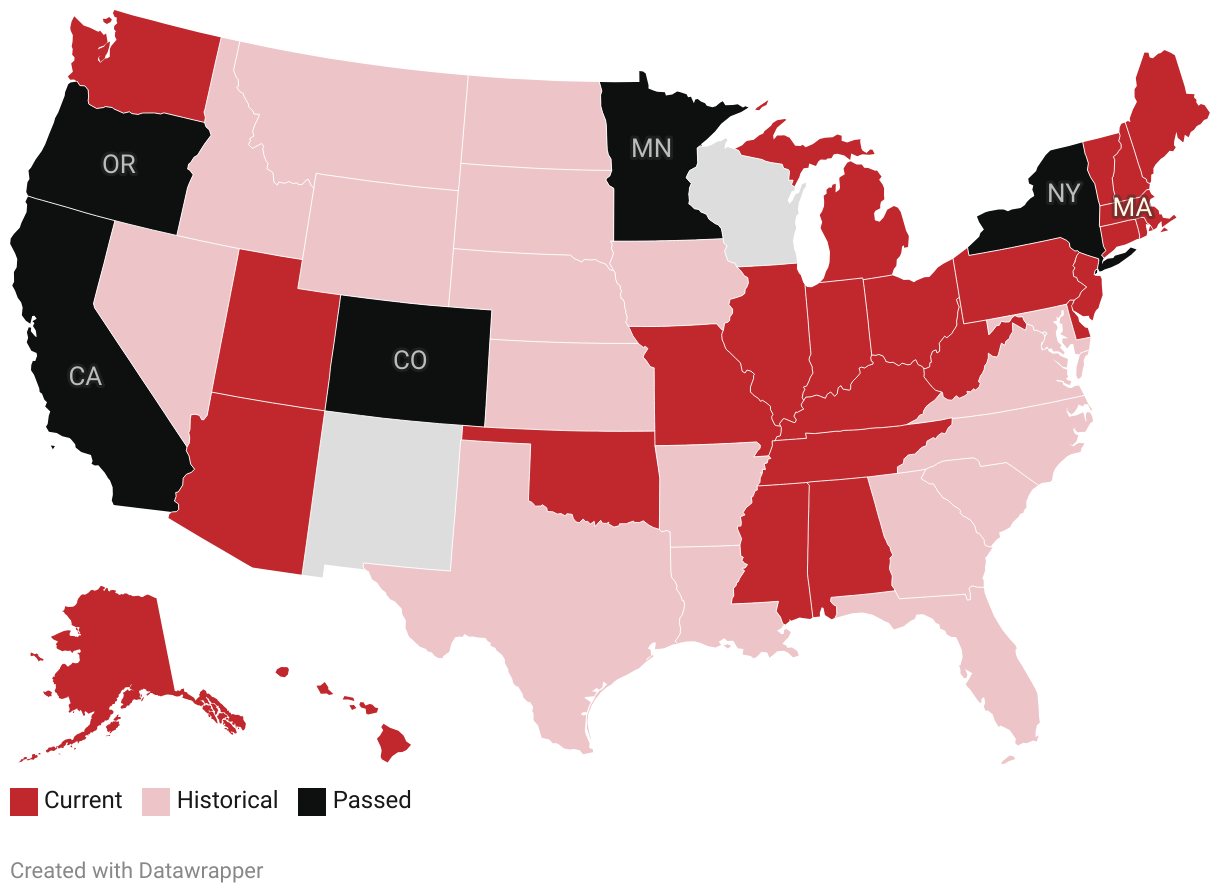
Tip: Hover your cursor over a state to see more details in a tooltip. Click the state to freeze the tooltip and click again to unfreeze.
Where things stand right now
Right to Repair laws
this session
legislation
already covered
About 90 seconds. We'll show you the message before it sends — edit it or send as-is.
Step 2: Bring three people with you
One letter is a data point. Fifty from one district is a meeting with the legislator. Send this to three people who've been told a repair "isn't authorized."
Step 3: Fund the Fight
We're a small team going up against Apple, John Deere, and the trade associations they bankroll. Membership dues are what pay for lobbyists in state capitols, expert testimony at hearings, and the bill tracking that keeps this map current.
Individual membership is $10/month — about one-third of the cost for an out-of-warranty screen replacement part.
An email, you ask? Yes, we keep it old school but vital. We unite businesses and consumers from various sectors to push for repair rights. Our monthly updates provide the crucial insights you need to act locally. We don’t mince words, we tell you exactly what you need to know.
Prefer to give once? Make a one-time donation →
Not ready to join? Get the monthly bill update →
Right to Repair FAQ
Modern equipment often includes proprietary technology parts. Manufacturers restrict access to repair services, claiming potential violations of their rights. In truth, this is a marketing strategy, as the law doesn’t grant manufacturers control over property post-sale. Such limitations affect equipment trade in the used market.
For a deeper treatment, we recommend The End of Ownership: Personal Property in the Digital Economy by law professors Aaron Perzanowski and Jason Schultz (MIT Press, 2016).
Your message goes to the state senator and state representative for your address. You don’t need to know who they are — we look them up for you.
You’ll see the full text before anything sends, and you can rewrite any part of it. Letters in a constituent’s own words carry noticeably more weight in a legislative office than identical form letters, so it’s worth changing a line or two.
You’ll get a copy by email, and we’ll let you know when your state’s bill moves.
We use it to identify your legislators and to show their office that you’re a constituent. That’s the entire reason it’s required — legislative offices discount mail from outside the district.
Our action forms run on Action Network. We don’t sell your information, and you can unsubscribe from updates using the link in any email. See our privacy policy for details.
Right to Repair does not impact warranties. Manufacturers will continue offering warranty services. Generally, consumers resort to independent repair services after the original warranty period ends.
No. The U.S. Copyright Office (USCO) clarified in 2016 that copyright law does not prohibit repair, customization, security research, or resale. They acknowledged that manufacturers unfairly remove legal rights via deceptive contracts, a situation addressable through state law.
The bill mandates Original Equipment Manufacturers (OEMs) to provide consumers and independent repair businesses with equal access to repair documentation, tools, diagnostics, service parts, and firmware.
Most repair restrictions stem from contracts such as End User License Agreements (EULAs), which limit equipment usage. Since contracts fall under General Business Law, state-level legislation is critical to address these limitations.
“Fair Repair” or “Right to Repair” legislation secures the consumer’s right to choose their equipment’s repair terms, encouraging a competitive local repair and resale market.
Yes. The Right to Repair concept aligns with current laws for auto repairs in Massachusetts and the National Memorandum of Understanding (MOU) supporting independent auto repair. The MOU model has proven beneficial for consumers without negatively impacting manufacturers.
The Right to Repair requirements target manufacturers, not distributors, retailers, or franchisees. Manufacturers will determine the best method for providing parts and information.
No. Existing state laws limit manufacturers’ liability disclaimers. Any harmful design or manufacturing defects remain the manufacturer’s responsibility, regardless of equipment usage or repair.
No. Manufacturers already possess the required information under Right to Repair for their authorized repair services. No new requirements are being introduced.
Firmware settings crucial for repair also enhance device security. The U.S. Copyright Office supports users’ rights to modify their firmware for security improvements and research.
No. The law safeguards copyrights, patents, and trade secrets. Intellectual property remains unaltered during repair. The legislation aligns with federal IP law and does not facilitate IP infringement.
Seeking repair rights restoration through courts is impractical and expensive. Plus, litigation targets one manufacturer at a time instead of addressing the issue as a policy matter. Hence, we focus on legislative solutions.
While our primary focus is the United States, we support global efforts to pass “Fair Repair” legislation. Repair advocates are working to introduce laws in various countries and regions. If you’re interested in contributing to these efforts or have specific inquiries, please contact us at [email protected].